Your Watch Said One Thing. Your Official Result Said Another. Here Is Why Both Can Be Right.

Photo: runner checking GPS smartwatch at race finish line official timing, via img.freepik.com
You cross the finish line, glance at your wrist, and see 47:23. Later that afternoon, you check the official results and find 47:11. Twelve seconds have vanished. Or perhaps they have appeared — your watch showed 47:31 and the official record shows 47:38. You are certain you did not slow down in the final stretch. So what happened?
This experience is nearly universal among runners who use GPS-enabled devices, and it generates more questions to race timing companies and event organizers than almost any other post-race topic. The reassuring answer is that in most cases, neither your watch nor the official result is wrong. They are simply measuring different things, using different methods, with different sources of imprecision. Understanding the distinction is essential for any runner who takes their performance data seriously.
The Fundamental Difference: What Each System Is Actually Measuring
Your smartwatch — whether a Garmin, Apple Watch, COROS, or any comparable device — uses GPS satellite signals to estimate your position at regular intervals, then calculates distance traveled and elapsed time from those estimates. It begins recording when you tell it to, and it measures the path you actually traveled, including every lateral step, water station weave, and tangent you may have run.
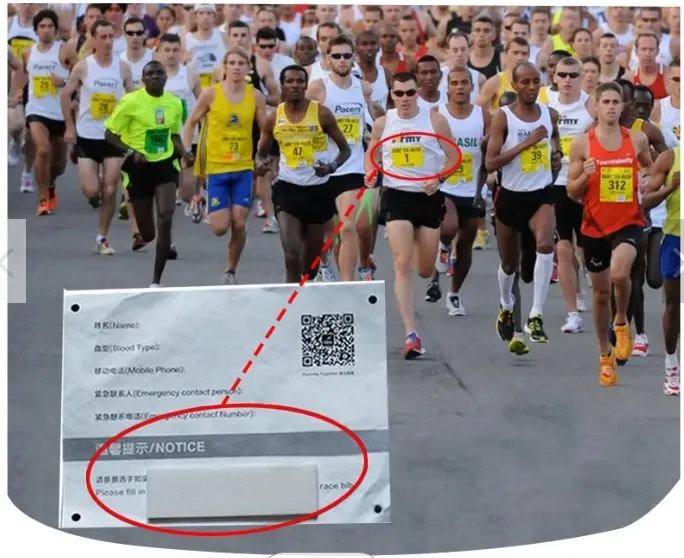
The official race timing system operates on an entirely different principle. A passive RFID chip embedded in your race bib or attached to your shoe communicates with antenna mats placed at the start and finish lines. When you cross a mat, the system records a precise timestamp. Your official chip time is the interval between those two timestamps — nothing more, nothing less.
These are fundamentally different measurements of fundamentally different things. One tracks your movement through space. The other records two moments in time at two fixed locations. The fact that they usually agree within a reasonable margin is, in some respects, more remarkable than the fact that they occasionally diverge.
GPS Drift: The Invisible Accumulator
GPS accuracy in consumer wearables has improved dramatically over the past decade, but it remains subject to systematic error under specific conditions. Tall buildings, tree canopy, canyon-like urban corridors, and even heavy cloud cover can degrade satellite signal quality and introduce positional drift. When your device calculates that you have traveled slightly farther than you actually have — a common outcome in dense urban race environments — it will also calculate a slightly faster pace than you actually ran.
The practical consequence: if your GPS watch believes you ran 3.13 miles when the certified course measured 3.10 miles, it will display a finish time corresponding to a faster average pace over a slightly longer distance. Your official time, anchored to the physical mat crossing, will appear slower by comparison.
This effect compounds over longer distances. GPS drift that amounts to a few seconds over a 5K can translate to a minute or more over a marathon. Runners training for Boston qualification or age-group records should be particularly cautious about using GPS-based finish time estimates as their primary performance benchmark.
Course Measurement and the Tangent Problem
USATF-certified courses are measured by a specific protocol involving a calibrated bicycle wheel and a method designed to calculate the shortest possible legal path a runner could travel. This is not the path most runners actually run. In practice, runners navigate around other competitors, drift wide on turns, and rarely execute the geometric ideal of every tangent.
Your GPS watch measures the path you ran. The official distance measures the path you could have run. If you added 0.05 miles by running wide through turns and weaving around congestion, your watch recorded that additional distance — and will compute your finish time accordingly. The official timing system does not know or care about the path you took; it simply recorded when you crossed the mats.
This is one reason why running coaches consistently advise athletes to use official chip times, rather than GPS-derived pace data, as the authoritative record of race performance.
Start Line Positioning and Chip Time vs. Gun Time
For runners who line up in corrals behind the start mat, the gap between gun time and chip time is well understood. But the positioning of timing mats relative to the physical start line can also introduce subtle discrepancies that surprise athletes.
At some events, the timing mat is positioned several feet behind or ahead of the physical start line marker. If your watch auto-starts when you cross what you perceive as the start line — or when you press the button after the gun fires — and the timing mat is in a different physical location, the two clocks begin at slightly different moments. Over the course of a race, that offset persists as a fixed discrepancy in your final times.
Similarly, finish line mat placement matters. Timing mats are typically placed before the official finish line banner, after it, or directly beneath it — and the specific location varies by event. Your watch records your time when you stop it, which may be several strides past the mat. The official result records the mat crossing.
When the Discrepancy Might Actually Be an Error
Most time gaps between watch and official result fall within the range of expected variation described above. However, genuine timing errors do occur, and athletes are entitled to question results that seem implausible.
Red flags worth investigating include: an official time that differs from your watch by more than two to three minutes on a course under 10 miles; a result that places you in an impossible position relative to runners you know you finished ahead of or behind; or a missing result entirely, which can indicate a chip read failure.
If you believe your result contains an error, the appropriate first step is to contact the timing company directly — not the race organization's social media account. Most professional timing operations maintain a results inquiry process. Provide your bib number, your estimated finish time, and any corroborating evidence such as GPS data or finish-line photographs. Reputable timing companies will investigate and, where warranted, issue corrections.
Before race day, it is worth asking event organizers two specific questions: whether the course is USATF-certified, and where the timing mats are positioned relative to the start and finish lines. These details will help you contextualize any discrepancy you encounter afterward.
Which Time Should You Actually Trust?
For purposes of personal records, age-group qualification standards, and any result that may be submitted to a governing body, the official chip time is the number that matters. It is the time that will appear in the race database, the time that counts for Boston qualifying purposes, and the time against which your performance will be compared in any official context.
Your GPS data remains valuable — not as a competing record of your finish time, but as a training tool. Pace distributions, heart rate overlays, elevation response, and split consistency are all insights your watch provides that official timing systems do not. Use each data source for what it does well.
At RR Timing Results, we believe informed athletes make better competitors. Understanding why your watch and your official result tell slightly different stories is not a reason for frustration — it is an invitation to engage more deeply with the data that defines your performance.